
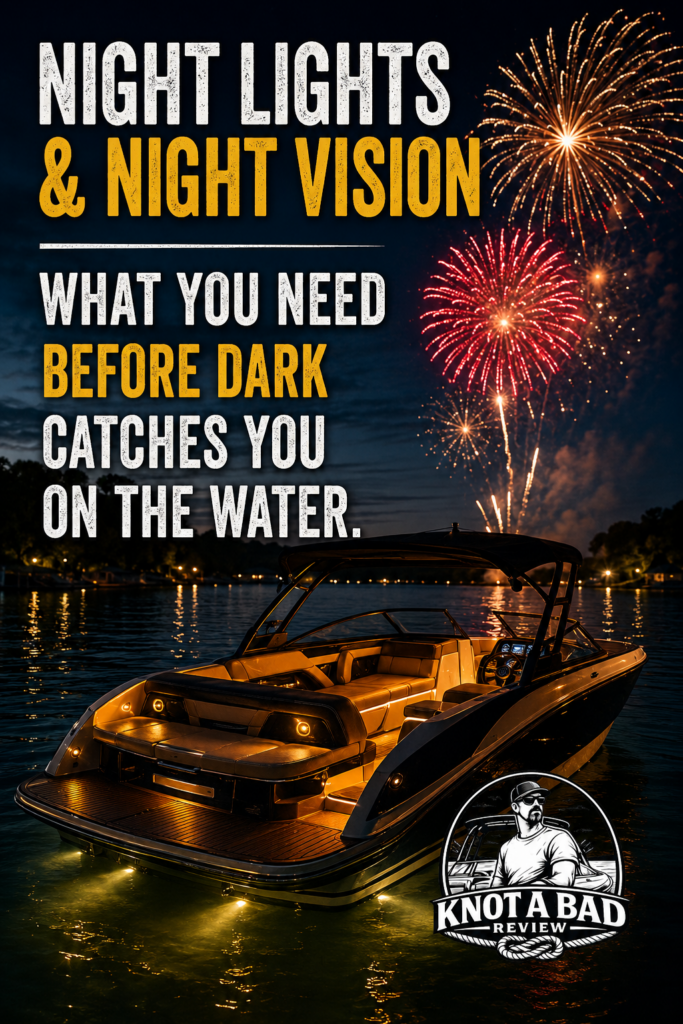
Every Fourth of July, boat lights for night boating turn from an afterthought into the difference between a great night on the water and a bad one. I watch the same thing happen on Joe Pool and Cedar Creek. Boats stack up along the shoreline for the fireworks show, everybody’s having a great time, and then the show ends and two hundred boats try to leave the lake at the same time — in the dark. That’s when I see running lights that don’t work, anchor lights nobody turned on, and more than one guy trying to find the boat ramp with his phone flashlight.
I learned this one the hard way a few years back at Lake Texoma, hanging around after a fireworks show with a group anchored off a cove. We didn’t leave until well after dark, and I realized my all-around white light had a dead bulb I hadn’t checked since the spring. Nothing happened — but running dark on a lake with two hundred other boats also trying to find their way home isn’t a mistake you want to make twice.
If you’re heading out this weekend, here’s what actually matters once the sun goes down.
Running Lights Aren’t Optional — And They’re Not All the Same
Federal law requires specific navigation lights any time you’re underway between sunset and sunrise, and the setup depends on your boat. A bowrider or runabout under 39.4 feet needs red and green sidelights, a white stern light, and a white all-around light (or masthead + stern combo) when at anchor or moving under power. Pontoons follow the same rules — the light housing is just usually mounted differently on the rail.
The mistake I see most is boats with the right lights installed that just don’t work, because nobody checks them between Memorial Day and Labor Day. Before you head out this weekend, run every light for sixty seconds at the dock. Bulbs die, connections corrode from lake water, and LED replacement kits are cheap enough that there’s no excuse for running with a bad one.
👉 Check price on Amazon | 👉 Check price on West Marine
An Anchor Light Isn’t Just for Anchoring
If you’re the type who parks off a cove to watch fireworks and then just sits there for another hour with the family, you need your all-around white anchor light on the whole time you’re stopped — not just your running lights. A lot of boaters don’t realize this is a separate requirement from underway lighting, and it’s exactly the situation that catches people out on the 4th, because everybody’s anchored watching the show with running lights off and anchor lights forgotten.
A solar-charged, pole-mounted anchor light is the easiest fix — mount it once, forget about it, and it charges all day sitting in the Texas sun.
👉 Check price on Amazon | 👉 Check price on West Marine
Deck and Underwater Lights — Nice to Have, Not Required, But Worth It
This is where you can have some fun. LED deck lights and underwater lights don’t satisfy any legal requirement, but they make a night on the water dramatically better — you can actually see who’s stepping in and out of the boat, find gear that rolled under a seat, and underwater lights draw baitfish if you’re the type to fish after dark. On a fireworks night, they’re also just a good time — a boat lit up blue or white under the waterline looks great anchored next to a cove full of families waiting on the show.
Stick with marine-rated LED strips — anything not rated for water exposure won’t survive a season of lake spray, and corroded wiring in the bilge is a problem you don’t want.
👉 Check price on Amazon | 👉 Check price on West Marine
A Handheld Spotlight Earns Its Keep
Your running lights help other boats see you. They don’t help you see the swim platform, the dock cleat, or the idiot who anchored fifty feet off the no-wake buoy with no lights on at all. A good handheld spotlight — rechargeable, at least a few hundred lumens — is what gets you back to the ramp safely once the fireworks crowd starts moving at once.
I keep mine clipped near the helm, charged before every trip. On a night like the 4th, when the lake empties out all at once, that spotlight is the difference between confidently picking your way through anchored boats and guessing.
👉 Check price on Amazon | 👉 Check price on West Marine
What About Night Vision?
I get asked about night vision monoculars more than you’d expect, usually from guys who do a lot of night fishing on quieter water like Possum Kingdom’s upper coves. Honestly — for a typical Fourth of July night on a crowded lake, you don’t need one. Between your own lights, the spotlight, and every other boat’s running lights, visibility isn’t the problem. Where a basic digital night vision monocular earns its cost is if you’re regularly running dark water far from other boat traffic and want to spot obstructions, wildlife, or the shoreline before you’re right on top of it. It’s a nice-to-have for the serious night angler, not a Fourth of July essential.
Boat-Type Notes
Pontoon owners: check that your rail-mounted lights haven’t gotten knocked loose or covered by a bimini top — I’ve seen more than one pontoon with the stern light physically blocked by folded canvas. Center console and jet boat owners running higher engine heights should double check sidelight visibility isn’t obstructed by rod holders or hardtops. Whatever you run, the test is simple: stand behind, then beside, then in front of your own boat at the dock before dark and confirm every light is visible from where it needs to be seen.
However you’re spending the Fourth — anchored off a cove waiting on fireworks, or running the lake after — do a light check before you leave the dock. It takes two minutes and it’s the difference between a great night on the water and being the boat everyone else is trying to avoid in the dark.
This post links back to How to Choose the Right Boat Anchor as part of our ongoing boat gear series.
As always, these are recommendations for gear I’ve actually used on the water — not just what pays the best commission. Knot A Bad Review may earn a small commission on purchases made through the links above, at no extra cost to you.
Tight lines. — Captain Knotsworth ⚓