
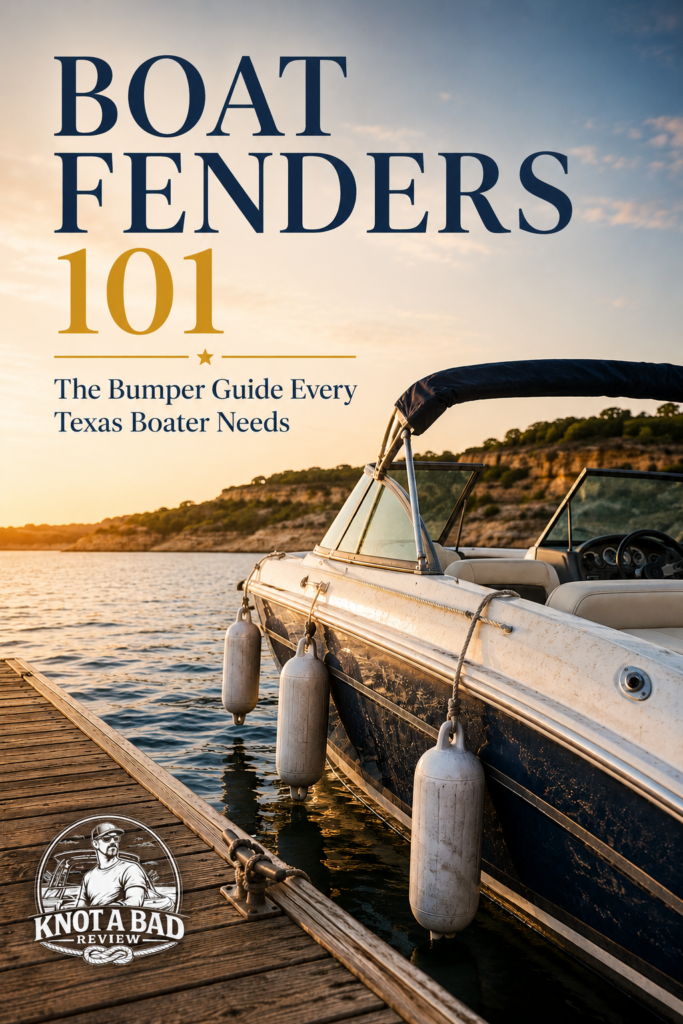
Boat fenders are cheap insurance, and I’ve scraped enough gelcoat off the port side of my bowrider to know it the hard way — a fender you didn’t bother to hang, or hung two feet too high, might as well not exist. I learned that one at the courtesy dock at Joe Pool on a windy Saturday, watching my hull grind against a piling while my fenders swung uselessly above the impact zone. Most boaters just don’t buy enough of them, or the right kind, or hang them in the right spot.
So let’s fix that. Here’s everything I’ve picked up over 30 years of docking, rafting up, and occasionally misjudging a crosswind on Texas lakes — the same lessons that shaped how I pick the right ground tackle for these lakes too.
Boat Fenders vs. Bumpers — Same Thing, Different Mouth
Around the marina you’ll hear both words for the same piece of gear — the inflatable or foam-filled buffer that keeps your hull off the dock, the piling, or your buddy’s boat when you raft up. “Fender” is the proper marine term; “bumper” is what most weekend boaters call it, borrowed from the car world. I use them interchangeably in conversation, and so will you by the end of this article, but on the water, everyone will know what you mean either way.
The Main Types You’ll Actually Use
Not all boat fenders are built for the same job, so here’s how the common styles break down. Cylinder fenders are the ones you’ve seen a thousand times — long, round, and hung vertically off a dock line. They’re the most versatile shape out there and the right call for the vast majority of runabouts, pontoons, and bowriders on Texas lakes.
Ball fenders are the round ones, and they earn their keep on bigger boats or anywhere the hull flares out toward the bow. Because they’re wider, they hold the lower hull off the dock even when the boat leans in, and a properly inflated ball fender is tougher to crush on impact than a cylinder of the same size.
Low-freeboard fenders are built for boats that sit close to the water — bass boats, some pontoons — where a standard cylinder would ride too high to protect the rub rail. Fender cushions, flatter and squishier, are made for pilings rather than straight dock edges, since a round fender tends to squirt out sideways when it’s squeezed against something narrow. And transom fenders hang off the back of the boat to protect the swim platform when you’re backed up to a dock, which matters more than people expect at crowded lake marinas in the summer.
Sizing: The Rule of Thumb That Actually Works
For cylinder fenders, aim for one inch of diameter for every four to five feet of boat length. So an 18-foot bowrider wants roughly a 4-inch fender, and a 25-foot boat should be running something closer to 6 inches. Ball fenders run a slightly different ratio — about two inches of diameter per four to five feet of boat length — because the whole point is a fatter buffer.
If your boat is heavier than average for its length, or you’re mooring somewhere with wake chop or a lot of boat traffic (looking at you, Lake Travis on a July weekend), size up. A fender that’s borderline on paper is undersized in practice once a wake rolls through. Polyform’s own sizing chart backs up these ratios if you want to double-check your own numbers.
How Many Fenders — and Where They Actually Go
The rule I use: one fender for every ten feet of waterline, with three as an absolute minimum even on a small boat. A 20-footer needs three; a 40-footer needs four or more. At least one fender has to sit at the boat’s widest point (the beam), with the rest spread fore and aft from there — not clustered in the middle where they do nothing for your bow or stern.
Height matters as much as count. If you’re tying up to a floating dock, hang fenders so the widest part sits just above the waterline — that’s your actual contact zone. Pilings are trickier, since they tend to shove a round fender aside right when you need it most. If you dock somewhere with pilings regularly, a fender board — a flat board slung between two fenders — spans the gap and keeps the piling from finding the one spot your fenders don’t cover.
What Texas Lakes Do to Fenders That Other Guides Won’t Tell You
Freshwater is easier on gear than saltwater, so you won’t deal with the corrosion problems a coastal boater does. But Texas sun is its own enemy. Vinyl fenders left inflated and hanging all summer at Cedar Creek or Possum Kingdom take a beating from UV exposure, and cheap vinyl will crack and fade a season or two faster than a quality one. Buy once, buy right, and you won’t be replacing fenders every spring.
Rocky shorelines at places like Possum Kingdom and Granbury also chew through fenders faster than a sandy-bottom lake would. If you’re beaching or anchoring near rock instead of tying up at a proper dock, a cushion-style fender or a higher-durability vinyl is worth the extra few dollars.
Fenders Worth Buying
I run Polyform’s G Series on my own boat — molded ribs keep them from rolling out of position, they ship pre-inflated to the right PSI, and the vinyl has held up through three Texas summers without cracking. West Marine carries the full G Series lineup, and they’re also on Amazon if that’s easier for you.
Taylor Made’s Big B fenders are the other name that comes up constantly among boaters I trust, with a seamless build and molded ribs that do the same anti-roll job. Also available through West Marine and Amazon .
Either brand will outlast the bargain-bin fenders at the big box store, and given how cheap insurance a good fender is against a gouged hull, this isn’t where I’d cut corners.
The Bottom Line
Buy enough boat fenders for your boat’s length, size them to your hull, hang them at the waterline instead of guessing, and spend a little more on quality vinyl that can survive a Texas summer. Do that and you’ll spend a lot less time explaining new gelcoat scratches to whoever you bought the boat from.
This post contains affiliate links. As an Amazon Associate and West Marine affiliate, I earn from qualifying purchases at no extra cost to you.
Tight lines. — Captain Knotsworth ⚓